
Same Old Song
A Story of History Rhyming

If you’ve been around the Porch a while, you know I’ve got a documentary rattling around in me called “When Did Music Stop Being Fun?” The short version of the thesis is this: everybody tells the story of the music business as a tragedy. Big bad Napster came along, then burning, then streaming, and the noble record industry got robbed blind and never recovered. Pirates killed music. You’ve heard it a hundred times.
That story is wrong. Not a little wrong — wrong at the foundation.
Here’s what actually happened. For about fifteen years, the record industry pulled off the single greatest sales trick in the history of entertainment: they convinced all of us to buy the music we *already owned*, again, on a shiny new format. You had the White Album on vinyl? Buy it again on cassette for the car. Got it on cassette? Here’s the CD, no hiss, lasts forever. The CD wasn’t a product. The CD was a permission slip to re-sell the entire back catalog of recorded music to the same people who’d already paid for it once.
I should know. I gamed the record clubs across five different addresses — and my brother’s, God rest the favor — twelve CDs for a penny, every time, just outrunning the bill collectors from one P.O. box to the next. Even I, a kid with no money in rural North Carolina, was swimming in cheap music. The whole thing was a flood, and the labels were the ones who opened the dam.
So when the CD re-buying boom finally ran out — when everybody had finally repurchased everything they were ever going to repurchase — revenue was always, *always* going to fall off a cliff. Napster didn’t push it off the cliff. Napster just happened to be standing there when gravity did what gravity does. The bubble was the anomaly. The crash was the correction. Reversion to the mean, plain as day.
Look at the line:
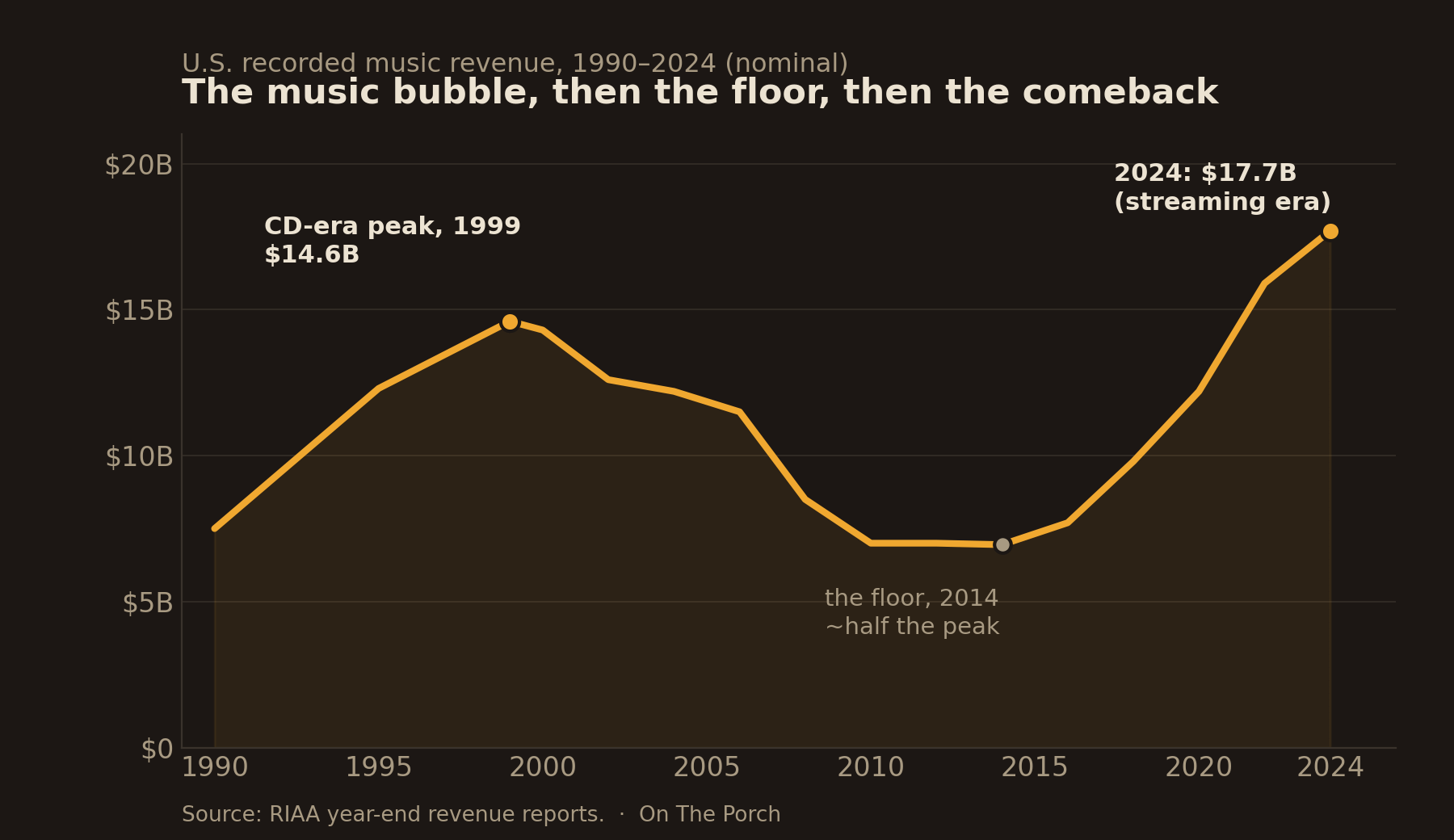
See that hump? That’s the lie. That peak in 1999 — about $14.6 billion — that’s not “music at its healthy normal.” That’s a one-time sugar high from selling people “Rumours” for the third time. Strip the CD bubble out and draw where the trend was always heading, and you land just about exactly where we actually are today. In 2024, U.S. recorded music revenue hit a record $17.7 billion. A record. The industry that supposedly got murdered is bigger than it’s ever been.
Music didn’t die. It just stopped being a scam, and the scam was the part that paid so well.
For a long stretch — roughly 2001 to 2013 — I was largely housebound. Panic disorder, agoraphobia, the whole nasty package. The world shrank down to a few rooms. And in those rooms, I read. I read everything. But the center of my whole day, the ritual that held the hours together, was the newspaper.
Not one newspaper. Five, at least. The Wall Street Journal, the New York Times, the Washington Post, the LA Times, the Boston Globe — every morning, free, on a screen, the best journalism in the country laid out in front of a guy who couldn’t make it to the end of his own driveway. I could read the Journal’s take and the Times’ take on the same story and triangulate my way to something like the truth. It was a genuine education. It might have saved my life, honestly — it kept a mind working that had nowhere else to go.
And here’s the thing I never once stopped to ask in all those years: “how was all of this free?”
It was free for the exact same reason my twelve CDs were a penny. Somebody else was paying, and paying a fortune, and the free stuff was just the bait on the hook.
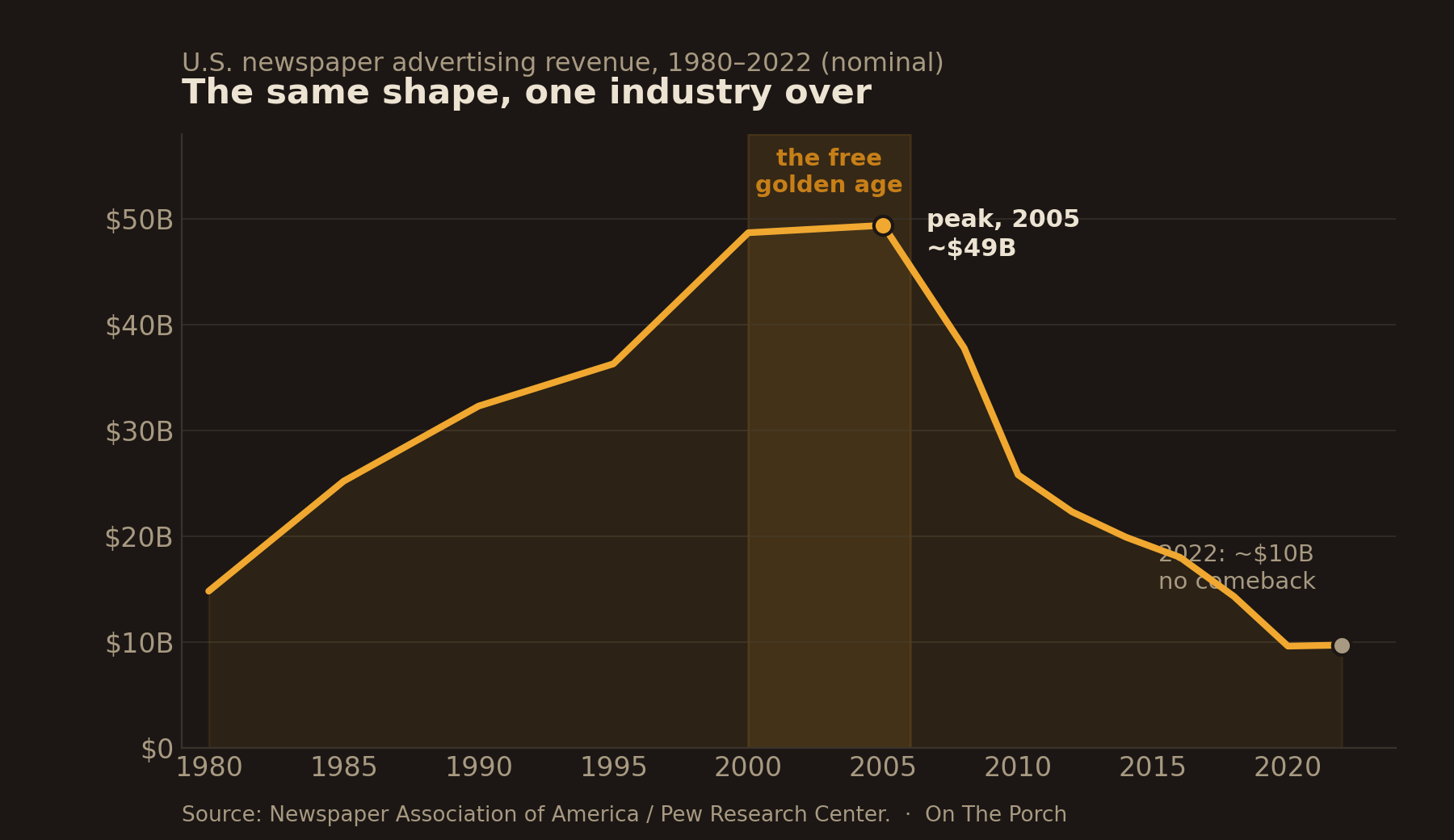
Look at that line. Tell me you don’t recognize it. It’s the same hump. One industry over, a few years shifted, but the same exact shape — a mountain that rises and then falls off a cliff.
That mountain is print advertising. In 2005, American newspapers pulled in around $49 billion in ad revenue — the all-time peak. Classified ads, mostly. Help wanted, cars for sale, apartments for rent, the personals. That river of money paid for the foreign bureaus and the statehouse reporters and, yes, the free websites that a housebound man in Wilkes County was reading at six in the morning. The website wasn’t the business. The website was a free sample stapled to the front of the most profitable local-monopoly business of the twentieth century.
And then the same thing that happened to music happened to news. The river got diverted. Craigslist took the classifieds — why pay forty bucks for a couch ad when it’s free? Google and Facebook took the display ads — by 2017 those two companies alone were swallowing somewhere between 60 and 70 percent of every digital ad dollar in the country. The newspaper got “unbundled”: the weather went to a weather app, the scores went to ESPN, the listings went to Yelp, the classifieds went to Craig. And once you pull all those pieces off, you’re left holding the one thing that’s expensive to make and easy for anyone to copy — actual reporting — with nothing left to pay for it.
So the line fell off the cliff. From $49 billion to about $10 billion. Newsroom jobs went from around 74,000 in 2006 to barely 30,000 by 2020. The bait got too expensive, and they reeled the hook back in. That’s the paywall. That’s the locked door my buddy and I are standing outside of. We didn’t get locked out because the world got greedy. We got locked out because the free era was never the real price — it was the penny CD, and the bill finally came due.
It’s the same old song. Same melody, second verse. Both industries built a bubble, mistook the bubble for solid ground, then spent twenty years blaming a villain — the pirate, the blogger, the platform — for a fall that was baked in from the start. The Four Tops could’ve written a white paper.
But here’s where the song changes key.
Look back at those two charts side by side. The music line falls off its cliff — and then it climbs back up. Streaming came along and gave people a new reason to pay, and now the business is healthier than ever. The crash was real but the recovery was real too. Annoying for the labels in the lean years; a tragedy for almost no one. We have more music, more cheaply, more easily, than at any point in human history.
Now look at the newspaper line. It falls off its cliff and it *stays down.* No streaming came to save it. There’s no recovery hump.
Why? Because — and this is the whole thing, this is what I’ve been circling — the true price of real journalism was never zero, and never close to it. It was always subsidized. By classifieds in my lifetime. By political parties before that. By the U.S. Post Office, which literally subsidized mailing newspapers starting in the 1790s because the founders thought an informed public was worth public money. Strip the subsidy away and the market doesn’t settle at “a leaner, healthier press.” It settles at too little. Because almost nobody will voluntarily pay the real cost of sending a reporter to sit through a four-hour county commission meeting on a Tuesday night.
That’s not a guess. Since 2005 this country has lost nearly 3,500 newspapers and more than 270,000 news jobs. Around 50 million Americans now live in a place with little or no local news at all. They call them news deserts, and I’d bet money there’s one within an hour of wherever you’re reading this. When the music bubble popped, we got Spotify. When the news bubble popped, we got a Facebook group where the loudest crank in the county “reports” on the school board.
The quality didn’t disappear, understand. It went premium. The New York Times, that paper I read for free every morning of my worst years, has something like 12.8 million paying subscribers now and just cleared $2 billion in digital revenue, partly by re-bundling itself — they’ll sell you the news and the crossword and Wordle and the recipes, the same bundle they used to give away, except now you pay the paper directly instead of the advertiser paying for you. Good for them, genuinely. But that model only works for a handful of national brands with a moat. The same week the Times announced records, the Washington Post announced it was cutting a third of its staff. Quality didn’t just go behind a fence. It consolidated behind a tall one, in a nice neighborhood, and most of the country can’t see over it.
Here’s the joke I can’t get away from. This essay — the one you’re reading right now, for free, on a Substack — is the new model. When you can’t sell the facts, you sell the sensibility. It’s why so much of what’s left reads like opinion now — not because we all got more opinionated, but because a point of view is the only thing an individual can actually defend and price.
And the river’s still moving. The newest verse is already playing: now the AI engines — the ones a lot of you use, the one I used to help me wrangle these very numbers — sit between you and the reporting, read the article, and hand you the summary so you never click through, never see the ad, never hit the paywall, never pay the writer. The Times is suing over exactly this. The carousel turns one more time. Free music, free news, and now free answers, with the same question hanging over all of it: “who’s paying to fill the well you’re drinking from?”
The free golden age was never free. It was the penny CD. And we are about to find out, the hard way, what a country looks like when nobody’s willing to pay the real price of knowing what’s actually going on in the background.
It’s the same old song. I just wish I knew how this one ends.
R.E.M. had a title for that feeling, too.